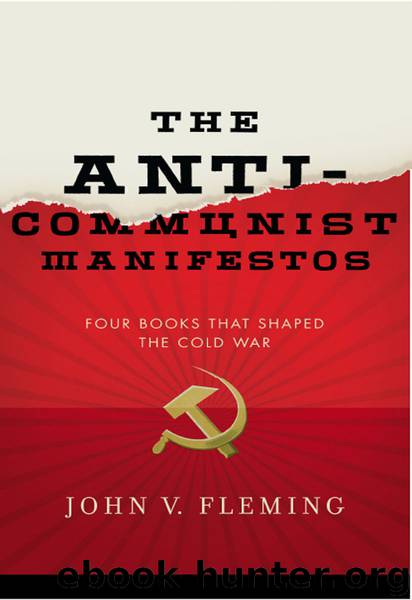
The Anti-Communist Manifestos by John V. Fleming
Author:John V. Fleming
Language: eng
Format: epub
Publisher: W. W. Norton & Company
Published: 2009-04-15T04:00:00+00:00
KRAVCHENKO AND THE FBI
To Gary Kern, a professional scholar who recently published an exhaustive book on the Kravchenko case, goes the considerable credit of wresting the FBI files from an unnecessary and certainly unhelpful secrecy.* The bureau’s files concerning Kravchenko are bulky, and, as available under the Freedom of Information Act, they are riddled with the annoying censors’ deletions that make of them something of a giant Sudoku grid. But Kern has analyzed them thoroughly. Our purposes are adequately served perhaps by the long summary memorandum prepared for J. Edgar Hoover by Hoover’s right-hand man, D. M. Ladd, completed on April 11, 1944, a week after the dramatic press conference with the New York Times.
Although the FBI had been long aware of Kravchenko’s activities, contacts, and intentions, they were blindsided by two aspects of the defection. The first was the length, eloquence, and political potency of Kravchenko’s published statement. Though inexperienced and indeed naive in many of his assumptions, Kravchenko had a sensitive regard for the delicacy of the international situation. (He also had a much more accurate view of Stalin’s intentions than the president of the United States or his secretary of state, but that is another matter.) The United States and the Soviet Union were military allies locked in a desperate struggle with their common and detested Nazi foe. Kravchenko regarded himself, with good reason, as a Russian patriot. He wanted to do nothing to harm Allied unity or to comfort the German enemy, and he was genuinely mortified when Goebbels immediately picked up the New York Times story for purposes of his own propaganda. Under these circumstances, Kravchenko had planned to limit himself to a very modest and general “statement of resignation” of no more than 100 words. He conveyed this intention to his FBI contacts.
When he got to New York on the Friday, however, he was induced to change his mind. There appear to have been two principal factors. In the first place his friend Joseph Shaplen at the New York Times echoed the advice he had already received from his prospective literary agent and confidant Eugene Lyons. Both men thought that Kravchenko’s proposed minimal statement would hardly be newsworthy, and that certainly it would not be effective in laying the foundation for the prospective book that by now was looming as large in their imaginations as in his own. This was of course also the view of another adviser, the ubiquitous Isaac Don Levine. But Kravchenko had long thought of his “resignation” as an offensive rather than a defensive act. He wanted, in good Marxist fashion, to “strike a hard blow.” Like so many other “anti-Soviet” writers, he felt obliged to exploit his rare, indeed nearly miraculous opportunity to address a Western audience and to speak for millions of the mute oppressed. (Jerzy Gliksman actually entitled his book Tell the West; one of Solzhenitsyn’s titles is Warning to the West; and as early as 1930, a book by Vladimir Tchernavin was entitled I Speak for the Silent.
Download
This site does not store any files on its server. We only index and link to content provided by other sites. Please contact the content providers to delete copyright contents if any and email us, we'll remove relevant links or contents immediately.
| Anthropology | Archaeology |
| Philosophy | Politics & Government |
| Social Sciences | Sociology |
| Women's Studies |
The Secret History by Donna Tartt(19066)
The Social Justice Warrior Handbook by Lisa De Pasquale(12190)
Thirteen Reasons Why by Jay Asher(8897)
This Is How You Lose Her by Junot Diaz(6881)
Weapons of Math Destruction by Cathy O'Neil(6270)
Zero to One by Peter Thiel(5792)
Beartown by Fredrik Backman(5744)
The Myth of the Strong Leader by Archie Brown(5505)
The Fire Next Time by James Baldwin(5434)
How Democracies Die by Steven Levitsky & Daniel Ziblatt(5217)
Promise Me, Dad by Joe Biden(5148)
Stone's Rules by Roger Stone(5084)
A Higher Loyalty: Truth, Lies, and Leadership by James Comey(4958)
100 Deadly Skills by Clint Emerson(4922)
Rise and Kill First by Ronen Bergman(4784)
Secrecy World by Jake Bernstein(4746)
The David Icke Guide to the Global Conspiracy (and how to end it) by David Icke(4712)
The Farm by Tom Rob Smith(4504)
The Doomsday Machine by Daniel Ellsberg(4489)
